
ERP and MES in the Furniture Industry: Where Margin Hides When Volumes Stop Growing
European furniture makers have grown revenue on price, not volume - real output is still about 8% below 2018. With every order generating its own bill of materials and EUDR applying from 30 December 2026, margin and compliance now depend on the same thing: knowing where every part came from and where it is.
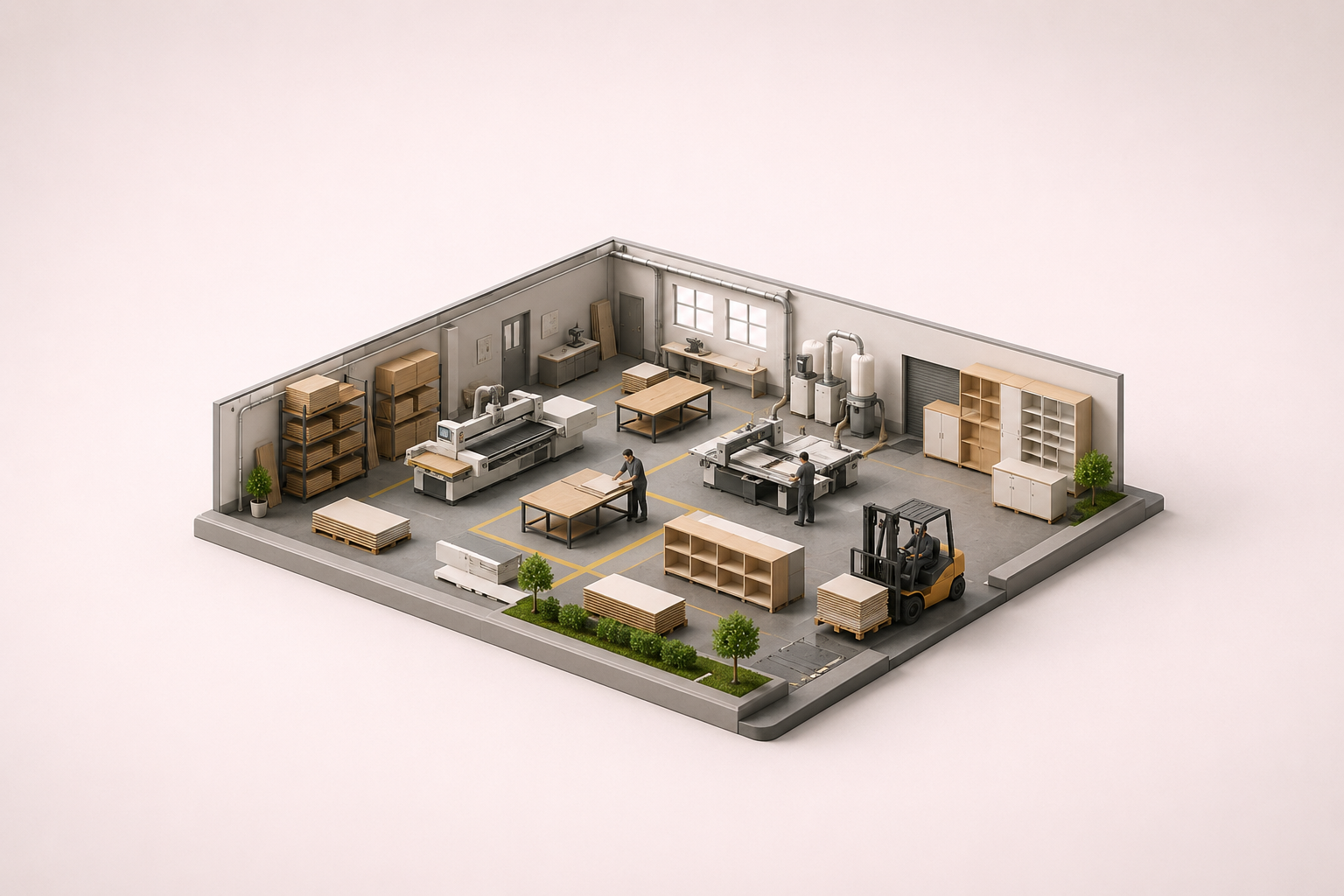
The European furniture industry sold roughly €124 billion worth of product in 2025 - and made less of it than it did in 2018. Real output was €98.6 billion, about 8% below pre-pandemic volumes, with the difference made up almost entirely by a 20.5% rise in producer prices between January 2021 and March 2023. Price has done the work for four years. It cannot do it for four more. That leaves the plant floor, where furniture manufacturing is unusually badly served by generic software - and where a deadline in December 2026 is about to make traceability a legal requirement rather than a nice-to-have.
Why standard ERP breaks on furniture
Most ERP systems assume a product has a bill of materials. Furniture, once you sell configurable product, does not - every order generates its own.
A study of one customised panel furniture manufacturer analysed 10,000 orders containing 462,325 individual panels: roughly 46 unique parts per customer order, each with its own dimensions, edge treatment, drilling pattern and routing. The same plant packed around 5.2 million panels a month (Wang et al., BioResources 16(1), 2021). Every one of those panels has to be cut from the right board, edged on the right side, drilled to the right pattern, and arrive at packing with the other 45.
That is what makes the sector hard:
- The BOM is generated, not stored. A configurable wardrobe has no master part list. It has rules that produce one.
- Quoting is engineering work. Without a configurator, every non-standard enquiry goes to a technician. Across 14 engineering-oriented companies, product configurators cut quotation lead time by an average of 85.5% (Haug, Hvam & Mortensen, AI EDAM 25(2), 2011).
- Batch and order production run on the same machines. Cutting wants to batch by material to save board. Assembly wants parts grouped by order. Those two demands fight, and the referee is either software or a supervisor with a clipboard.
- The long tail is enormous. Hardware, edge banding, finishes and fittings multiply far faster than the visible product range.
What you lose in the cut
Material is the dominant cost line in panel furniture, and the cutting plan decides how much of it becomes product.
Measured cutting yields for wood-based panels in furniture production range from 58.29% to 88.04% depending on material and layout - 19 mm plywood at the bottom of that range, OSB at the top (Konukcu & Zhang, BioResources 14(2), 2019). The gap between a good cutting plan and a poor one is, in the worst case, close to a third of the board.
The scale of small improvements is easy to underestimate. Researchers optimising board utilisation with an ant-colony algorithm noted that a 1% increase in utilisation would save roughly 193 million m³ of board in Chinese furniture production alone (Wang et al., Applied Sciences 11(17), 2021).
Then there is what happens after a mistake. In a study of panel furniture rework, the average production time for a reworked panel fell from 4.9 hours to 3.5 hours after the process was systematised - but the more revealing number is the one before: clearing a single "owed board" status in the manufacturing system took an average of 523 minutes, and staff spent dozens of hours a month physically looking for defective boards (Luo & Xu, BioResources, 2023). One missing part does not cost one part. It costs the order.
Tracking parts, not orders
The fix is not a bigger ERP. It is knowing where each part is.
Barcode or QR labelling applied at cutting and read at every subsequent station - edge banding, drilling, assembly, packing - turns 46 anonymous panels into 46 tracked objects. HOMAG's customer MS-Schuon, a 120-employee German manufacturer, described the change plainly after introducing part tracking: "What used to take several hours is now clarified in a few minutes."
The efficiency evidence is stronger than the sector's reputation suggests. Across 31 furniture companies in the Czech Republic, Germany and Slovakia that had adopted Industry 4.0 technologies - barcode and QR systems, CNC automation, automated inventory - researchers found overall operational efficiency rose 30-50% over five years, with the largest gains in atypical, custom production (Červený et al., Forests 13(12), 2021). A parallel survey of 144 Czech furniture enterprises found the sector as a whole is "generally at the Industry 2.0 level," with 72.7% naming a skilled-labour shortage and 72.7% naming finance as the main barriers (Sustainability 14(20), 2022).
Where MES is properly integrated with machine data rather than bolted on beside it, the effect concentrates at the bottleneck: one consultancy reports over a 40% throughput increase at a bottleneck edgebander once that integration was complete (Lignum Consulting, Woodworking Network, October 2025).
EUDR: the date most manufacturers have wrong
The EU Deforestation Regulation has been postponed twice, which has left a widespread and expensive misunderstanding about who has time.
Regulation (EU) 2023/1115, as amended by Regulation (EU) 2025/2650, applies from 30 December 2026 for large and medium operators. Micro and small operators get until 30 June 2027 - except those already covered by the EU Timber Regulation, who also face 30 December 2026. In practice, that is nearly every wood furniture manufacturer in the region.
Annex I settles any question of scope. It covers HS 4410 (chipboard and OSB), 4411 (MDF and fibreboard) and 4412 (plywood), plus headings 9403 30, 40, 50, 60 and 91 - wooden office, kitchen and bedroom furniture "and parts thereof." There is no flat-pack manufacturer out of scope.
What it requires is a due diligence statement carrying the operator's EORI number, HS code, quantity, and the geolocation of the plots where the wood was harvested, to six decimal places - a single GPS point below 4 hectares, a polygon above it. The December 2025 simplification means only the first operator placing goods on the EU market submits the statement; downstream operators and non-SME traders must instead collect and retain the reference number of that statement.
That retention duty is where this stops being paperwork. Once a board is cut into 46 parts and those parts are mixed across several orders, only a system holding part-to-batch lineage can answer which declaration covers which wardrobe. It is a lot genealogy problem in an ERP, not a folder in an office.
The penalty framework makes it worth solving properly: fines of at least 4% of total annual EU-wide turnover, confiscation of products and of revenue from their sale, temporary exclusion from public procurement and public funding, and publication of final judgments - including the company name - within 30 days.
The gap is the opportunity
Eurostat's 2025 data puts the problem in one line: 41.08% of small EU enterprises (10-49 employees) use ERP software, against 88.71% of large ones. Manufacturing overall sits at 57.62%.
That gap is not accidental. The researchers behind the Central European study named the cause directly: "Software solutions, machinery and companies supplying innovative turnkey Industry 4.0 solutions are mainly specialized for large enterprises." A 40-person manufacturer running configurable product is not a small version of a corporation. It has the same complexity per order and none of the implementation budget.
The regional stakes are real. Serbia's forestry, wood processing, furniture and paper complex exported €1.9 billion in 2025 - 5.7% of all Serbian exports, up 7.3% year on year - across 3,100 companies and 9,300 registered entrepreneurs employing 52,300 people, of whom 21,500 work in furniture. Almost all of that export goes into a market that starts asking for harvest geolocation in December 2026.
Volumes are not coming back quickly and prices have already been pushed. What is left is the board you already bought, the parts you already cut, and knowing exactly where both of them are.
Talk to us about your plant
We build this kind of system for manufacturers who are too specific for off-the-shelf ERP and too small to absorb a corporate implementation - connecting quoting, per-order BOM generation, cutting optimisation, barcode part tracking and lot genealogy into one flow that fits how your plant already works.
If EUDR is on your list for this year, or if you know your yield is leaking but not where, write to us. We will map your current flow from board receipt to packed carton and tell you honestly what is worth automating first - and what is not.
Tags
Need this in practice?
Get a proposal